

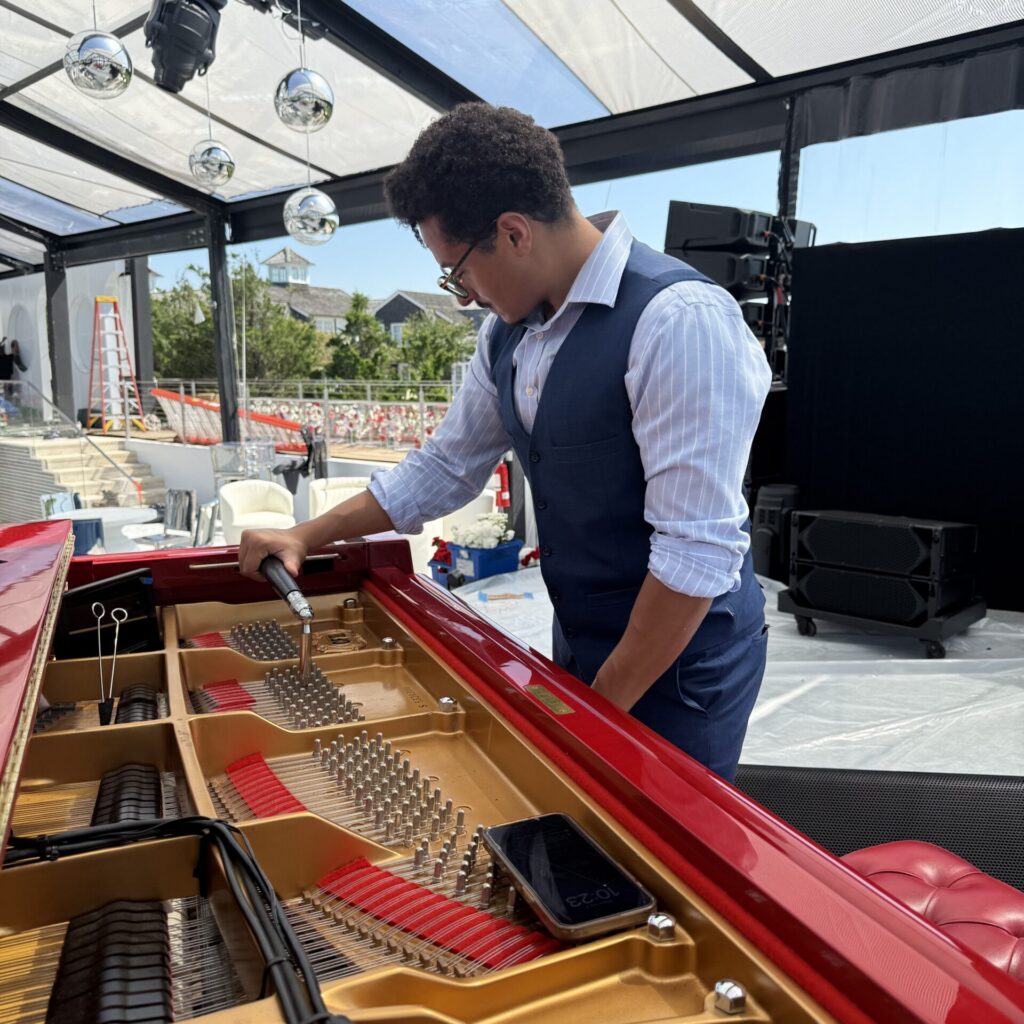
Reliable Piano Service Protects Sound, Value, and Performance
Piano service includes professional tuning, repair, moving, and restoration that keep an instrument stable, playable, and ready for lessons, rehearsals, or performances.
For a Long Island home, school, or music program, the quick rule is simple:
- Schedule routine tuning to keep pitch and touch consistent.
- Use a qualified technician for repairs, regulation, and climate-related problems.
- Hire trained piano movers for relocation or storage, not ordinary furniture movers.
A standard tuning usually takes about 70 to 90 minutes. Most manufacturers advise tuning a new piano about four times in its first year, then twice each year after that. Regular care matters because changes in humidity and temperature affect the piano’s wood, felt, strings, and action – often before the problem is obvious to the player.
The right provider does more than make a piano sound in tune. They help protect a cherished family instrument or a school piano from avoidable damage, unreliable keys, and costly surprises.

Comprehensive Overview of Professional Piano Service
When people hear the term piano service, they often think of a single task: tightening strings so middle C sounds right. In reality, comprehensive piano care covers the entire physical and mechanical health of the instrument. A piano is both a acoustic stringed instrument and a complex machine containing thousands of moving parts made of wood, felt, leather, and steel.
Over time, playing the piano and exposing it to indoor seasonal shifts causes components to wear down, shift, or fall out of alignment. Comprehensive care brings together multiple disciplines to keep your instrument operating at peak performance.
Core piano care services typically include:
- Routine Fine Tuning: Adjusting individual string tension to ensure accurate pitch and harmonic harmony across all 88 keys.
- Pitch Corrections (Pitch Raise): Conducting preliminary tension adjustments when an instrument has drifted far below standard pitch (A440).
- Mechanical Action Regulation: Calibrating key travel, escapement, and hammer drop to preserve touch responsiveness and control.
- Hammer Voicing: Softening or hardening hammer felts to adjust tonal color, brightness, and dynamics.
- Climate Control Installation and Service: Equipping the instrument with internal humidity systems to protect soundboards and pinblocks.
- Structural Repair and Re-stringing: Replacing worn bridge pins, broken strings, cracked key buttons, or loose tuning pins.
- Specialized Relocation and Storage: Transporting instruments using specialized equipment to protect delicate mechanical frames.
- Complete Restoration and Refinishing: Overhauling antique instruments, rebuilding action assemblies, and restoring wooden cabinets.
By understanding how these elements interact, piano owners can proactively address minor issues before they require major structural overhauls. Learn more about How Gifted Strings Keeps Pianos Sounding Their Best through integrated care routines.
Essential Maintenance: Tuning, Pitch Raise, and Climate Control
At the heart of any piano service plan is pitch maintenance. Acoustic pianos are engineered to sound their best at standard pitch, where A above middle C vibrates at exactly 440 Hz (A440). At this standard, the combined tension of the strings exerts upwards of 18 to 20 tons of force on the iron plate and wooden soundboard.
When environmental humidity fluctuates, the wooden soundboard swells and shrinks. In humid months, the soundboard expands, pushing up against the bridge and pulling the strings tighter (raising the pitch). In dry months, the soundboard crowns downwards, dropping string tension and causing the piano to sound flat.
If an instrument goes without tuning for a year or more, string tension drops significantly. When pitch drops by more than 15 cents flat (where 100 cents equals one musical semitone), a standard tuning session is no longer sufficient. The technician must perform a preliminary “pitch raise” or double pitch correction before fine tuning can occur.
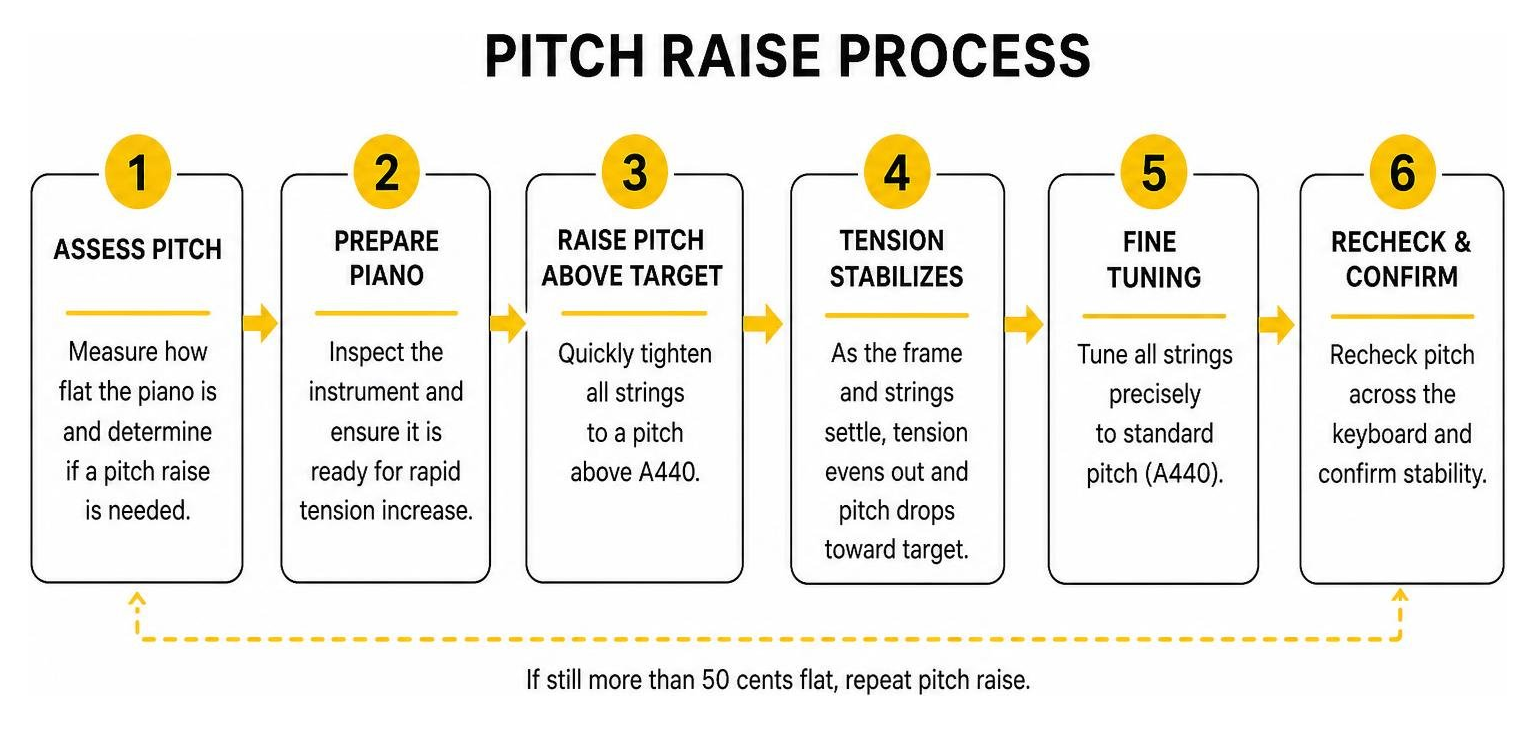
During a pitch raise, the technician rapidly pulls all strings slightly above target tension. Because bringing a severely flat piano back to pitch adds over two tons of total pressure back onto the iron frame and wooden structure, the frame shifts slightly as new tension is applied. The initial strings tuned will drop in pitch by the time the technician reaches the treble notes. Once the overall tension is stabilized, a fine tuning brings every string to precise frequency. If a piano is over 50 cents flat, it may require two preliminary pitch raises before holding a stable fine tuning.
To prevent severe pitch swings, maintaining internal climate stability is vital. Technicians target an internal relative humidity of 42%. Placing pianos on interior walls away from drafty windows, external doors, HVAC vents, fireplaces, and direct sunlight helps minimize timber movement. Installing internal climate control systems (such as a Dampp-Chaser Piano Life Saver system) helps regulate internal humidity year-round, expanding tuning stability and protecting pinblocks from loosening. For tailored pitch maintenance, explore our dedicated Piano Tuning Service.
Mechanical Action Regulation and Voicing as Part of Full Piano Service
While tuning addresses pitch, regulation and voicing govern how the piano feels and sounds under a pianist’s fingers.
Action Regulation: The mechanical mechanism inside a piano contains over 9,000 components. Over time, felts compress, wood shifts, and leather wears. Regulation involves adjusting key height, key dip, blow distance, let-off (escapement), backchecks, and repetition springs. Proper regulation ensures uniform resistance across all keys, eliminating sticking keys, double-striking hammers, or sluggish key returns. For grand pianos experiencing loose tuning pins during regulation, technicians may use specialized pinblock jacks to support structural integrity while setting pins securely.
Hammer Voicing: Once a piano is perfectly regulated and in fine tune, its voice can be shaped. Over thousands of impacts, hammer felts flatten and harden, producing a harsh, brassy, or overly bright tone. Voicing involves inserting needle tools into specific zones of the hammer felt to relieve compaction, or applying hardening solutions to soft felts to restore clarity. Voicing allows a technician to create a balanced, expressive tonal range from soft pianissimos to booming fortissimos.
Technicians always perform action regulation prior to hammer voicing, as correct mechanical hammer alignment and strike distance are necessary prerequisites for accurate acoustic voicing.
3 Simple Steps to Selecting the Right Piano Technician
Finding a trustworthy technician for your piano service does not have to be overwhelming. Following a clear evaluation framework ensures your piano receives safe, knowledgeable care tailored to its age and condition.
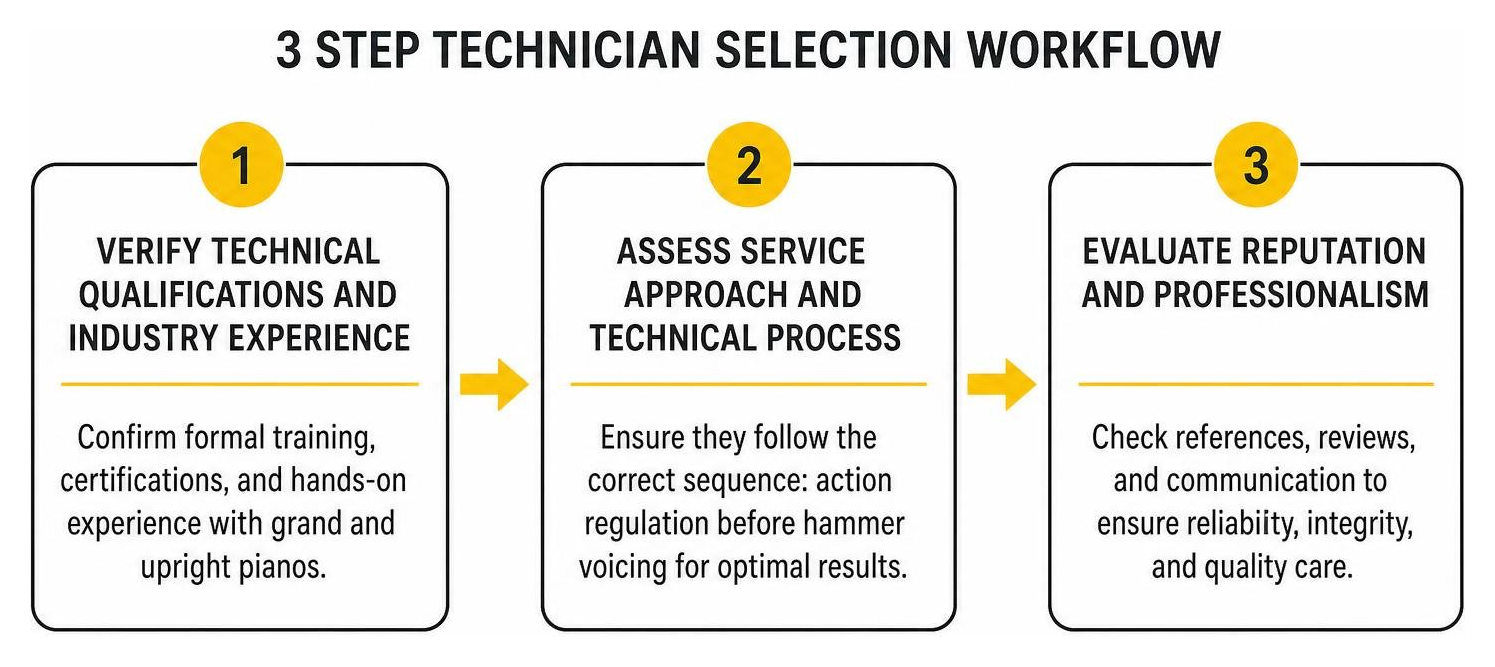
Step 1: Verify Technical Qualifications and Industry Experience
The first step in finding a reliable technician is assessing their formal technical background, certifications, and hands-on experience with diverse instrument types.
When vetting a service provider, ask about their experience across both grand and upright mechanical designs. Qualified technicians understand delicate structural elements like action geometry—the physical lever ratios between key depression and hammer strike speed. Adjusting action geometry requires deep technical knowledge to prevent creating keys that feel uncomfortably heavy or light.
Look for technicians who offer thorough pre-purchase and pre-service evaluations. A qualified professional will perform a structural assessment covering:
- Pinblock integrity and tuning pin torque.
- Soundboard crown and presence of stress cracks.
- Structural bridge condition and soundboard pressure.
- Action wear, felt compression, and key bushing alignment.
Scheduling an initial evaluation gives you an objective report on your piano’s mechanical baseline. Learn why this step is so crucial by reading Why Every Piano Owner Should Schedule a Professional Piano Inspection.
Step 2: Evaluate Comprehensive Offerings Beyond Basic Piano Service
A single quick tuning service is rarely all an instrument needs over a multi-decade lifespan. A top-tier provider offers full-lifecycle piano care, saving you the hassle of hiring different contractors for tuning, mechanical repairs, or cosmetic touch-ups.
Evaluate whether the provider handles:
- Minor On-Site Repairs: Fixing broken key buttons, splinting cracked keys, replacing broken treble strings, and repairing sticky dampers.
- Action Overhauls: Re-bushing keys, replacing hammer shanks, re-flange assembly, and action frame realignment.
- Player Piano Systems: Installing and maintaining modern electronic player systems (such as PianoDisc Prodigy, ProRecord, or QuietTime) as well as factory reproducing units like Steinway SPIRIO.
- Institutional Maintenance: Servicing institutional fleets across schools, houses of worship, and performance halls that demand frequent turnarounds.
Working with a provider who offers a full spectrum of work ensures your piano receives consistent care as its needs evolve. Explore our full range of instrument care options on our main Services page.
Step 3: Assess Specialized Logistics and Equipment Standards
Pianos are heavy, fragile, and sensitive to transport. The final step when selecting a piano service provider is verifying that their logistics and equipment standards protect your home and instrument.
A professional team relies on specialized gear designed specifically for instrument transport, including:
- Heavy-duty piano moving boards (skid boards) fitted with custom straps and protective padding.
- Specialized high-impact rubber dollies designed to distribute weight without damaging hardwood or tile floors.
- Climate-controlled transport vehicles that guard internal soundboards against extreme weather shifts during transit.
Technicians should also provide practical advice on home placement—recommending interior wall placement to isolate the instrument from external heat and cold. To prepare your home for an incoming service or transport team, review our comprehensive Home Prep Checklist.
Piano Moving, Repair, and Restoration Considerations
Whether you are relocating to a new home across Long Island or restoring a family heirloom that has sat untouched for decades, specialized logistics and structural repairs demand careful planning.
Relocation and Safe Storage Logistics
Moving a piano is not simply a matter of heavy lifting. Upright pianos weigh between 400 and 900 pounds, while grand pianos weigh anywhere from 500 to over 1,200 pounds. Attempting to move an instrument with standard household movers risks severe personal injury, costly property damage, and internal mechanical misalignment.
Professional movers protect structural integrity by:
- Disassembling Removable Components: Removing grand piano legs, lyres, and music desks, securing them in padded blankets.
- Distributing Frame Strain: Bolting grand piano cabinets onto specialized skid boards to protect internal plate stress points.
- Climate Stability: Transporting and storing instruments in climate-controlled environments to keep wood joints from splitting or glue lines from breaking.
Using one integrated firm for transport, tuning, and ongoing care streamlines your piano’s transition into a new space. Learn more about our specialized Piano Moving Service and discover Why Choosing One Company for Piano Moving and Repair Makes a Difference.
Assessing Reconditioning, Rebuilding, and Heirloom Restoration
Over time, every piano reaches a crossroads where simple tuning and light regulation are no longer enough to restore optimal playability. Understanding the difference between reconditioning and full restoration helps you choose the right path for your instrument.
- Reconditioning: Cleaning the internal action, resurfacing worn hammer felts, lubricating friction points, replacing individual worn springs, and tightening loose hardware. Reconditioning retains original structural components while optimizing existing parts.
- Full Restoration & Rebuilding: Overhauling classic instruments—such as vintage Steinway & Sons, Mason & Hamlin, or Baldwin pianos—by replacing key components. This process may involve installing a new pinblock, fitting a new soundboard, re-stringing treble and bass bridges, replacing action components, and completely refinishing the wooden cabinet.
Restoration can even resolve historical manufacturing defects or heavy action geometry issues present in older vintage builds, yielding a finished instrument that plays better than it did when brand new. Discover how we protect multi-generational family treasures through our Piano Restoration Service, explore our guide on How Gifted Strings Helps Preserve Family Heirloom Pianos, and compare detailed service paths in Piano Reconditioning vs Piano Full Restoration.
Service Costs, Extended Techniques, and Special Requests
Clear communication regarding service fees and performance requirements helps budget ongoing piano maintenance effectively.
Understanding Standard Tuning and Repair Costs
Piano maintenance pricing reflects the technician’s specialized skill, time required, and necessary parts. Below is a helpful summary of average service costs and estimated timeframes for common piano service tasks:
| Service Type | Typical Cost Range | Average Time Required | Key Inclusions |
|---|---|---|---|
| Standard Fine Tuning | $150 – $200 | 70 – 90 minutes | Pitch inspection, standard fine tuning (A440), minor pedal adjustments. |
| Tuning + Pitch Raise | $220 – $300 | 2.5 – 3 hours total | Preliminary pitch correction, stabilizing pass, fine tuning. |
| Complete Action Regulation | $900 – $1,200+ | 6 – 10 hours (or shop work) | Adjusting escapement, key dip, backchecks, blow distance, and repetition. |
| In-Home Inspection & Evaluation | $100 – $180 | 45 – 60 minutes | Detailed appraisal, pinblock check, action condition report. |
| Full Cabinet & Action Restoration | Varies widely | Weeks to months | Complete structural rebuild, pinblock, soundboard, and cabinet refinishing. |
Investing in routine tuning twice a year avoids the cumulative expense of repeated pitch corrections and preventable repairs down the line.
Handling Extended Techniques and Prepared Piano Requirements
In modern classical, avant-garde, and contemporary music performance, artists sometimes use non-traditional methods known as extended techniques or prepared piano modifications. These involve inserting objects (bolts, rubber wedges, screws, or felt strips) between strings, or directly plucking and striking strings inside the piano.
While these techniques yield unique sonic textures, they present distinct structural risks:
- Inserting hard metal objects can nick or scrape protective string coatings, causing buzzes or early string breakage.
- Touching strings directly with bare fingers transfers oils and perspiration, encouraging string oxidation and rust.
- Striking damper assemblies or soundboards directly can throw mechanical key regulation out of alignment.
Institutional collections (such as university piano technical programs managing hundreds of instruments) enforce strict guidelines for non-traditional performance requests. Performers are usually required to submit formal request forms weeks in advance so technicians can evaluate potential risks.
When hosting events that involve non-traditional performance methods, always consult your service technician beforehand. A professional technician can set up safe temporary dampening materials or designate specific instruments that can accommodate prepared piano requirements without causing long-term damage.
Frequently Asked Questions About Piano Maintenance
How often should a piano be tuned?
Most manufacturers recommend tuning a new piano four times during its first year in a home or facility. As new steel strings stretch and wood components settle under initial tension, pitch drifts quickly. After the first year, schedule fine tuning at least twice annually—ideally in spring and autumn following seasonal HVAC transitions. Pianos used in high-demand settings like performance halls or teaching studios may require monthly or pre-concert tuning sessions.
When is a pitch raise necessary during a tuning session?
A pitch raise is necessary whenever a piano’s pitch has dropped by more than 15 cents flat relative to standard pitch (A440). Because pulling flat strings back to standard pitch adds thousands of pounds of tension back onto the iron frame, the structure flexes slightly during the process. A preliminary pitch correction balances total frame tension quickly so the technician can perform a stable fine tuning afterward. Pianos that are more than 50 cents flat often require two preliminary pitch passes before a fine tuning will hold.
Why should standard furniture movers not relocate a piano?
Standard household movers generally lack the specialized equipment, structural training, and instrument-specific experience required to handle heavy, delicate pianos. Pianos carry enormous internal tension and delicate internal pinblocks and soundboards that can crack under improper lifting angles. Specialized piano movers use custom skid boards, custom straps, heavy-duty padded dollies, and climate-controlled transport vehicles to protect both the instrument and your home’s flooring, doorways, and staircases.
Conclusion
Investing in regular piano service keeps your instrument sounding rich, performing reliably, and retaining its value for generations. By following our 3 simple steps—verifying technical experience, assessing comprehensive service capabilities, and insisting on professional transport standards—you can build a lasting partnership with a trusted technician team.
At Gifted Strings Music, we bring over a decade of fully insured, instrument-specific expertise to homes, schools, and performance venues across Long Island. Whether your piano needs routine tuning, custom action regulation, specialized transport, or a complete heirloom restoration, our team delivers precision craftsmanship tailored to your instrument’s unique history.
Ready to restore the true voice of your instrument? Visit our Services overview to explore our complete care options, or Contact us today to Schedule your next professional tuning session. Additional industry resources and care guidelines are available via the Piano Technicians Guild.