


Common Structural and Mechanical Issues in Upright Piano Repair
An upright piano contains thousands of tightly fitted moving parts. Unlike grand pianos, which use gravity to return hammers to their resting position, upright pianos rely on small springs, bridle straps, and delicate mechanical leverage. When wood expands or contracts, or when felt degrades over decades, several predictable failures occur.
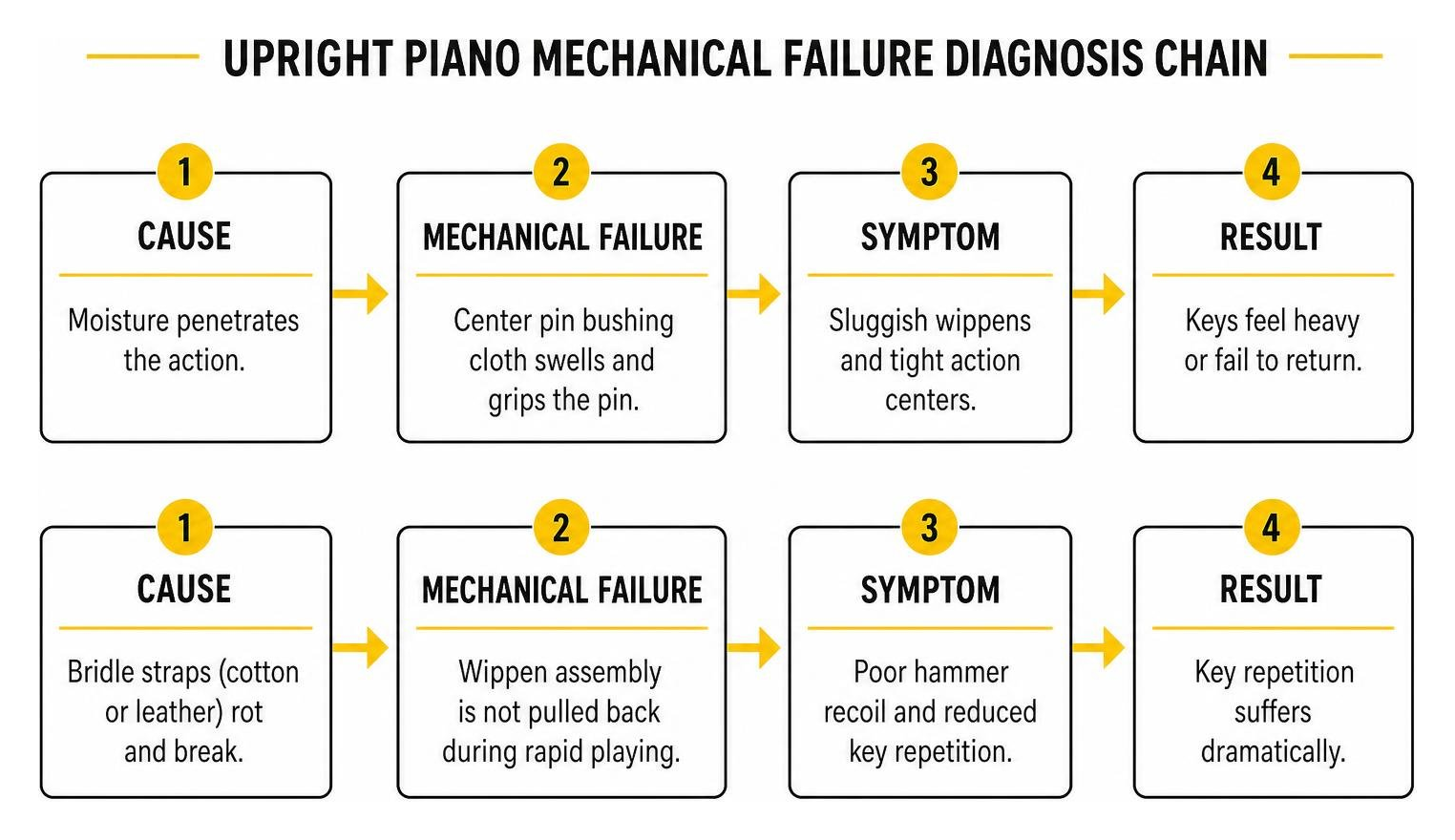
One common issue is sluggish wippens and tight action centers. These cloth-bushed center pin pivots allow the action levers to rotate smoothly. When atmospheric moisture penetrates the action, the bushing cloth swells, gripping the center pin and causing keys to feel heavy or fail to return.
Broken bridle straps are another common point of failure. Bridle straps pull the wippen assembly back during rapid playing to assist hammer recoil. When these cotton or leather straps rot and break, key repetition suffers dramatically.
Loose tuning pins represent a serious structural challenge. The pinblock (a laminated plank of hard rock maple) grips high-tensile steel tuning pins. Over decades, why your piano sounds different in summer vs winter comes down to seasonal swelling and contracting that crushes the surrounding wood fibers. Eventually, torque drops below the threshold needed to withstand string tension, making the piano drop pitch quickly.
Furthermore, soundboard crown loss occurs when years of fluctuating indoor climate flatten the soundboard’s subtle curvature. This reduces downbearing pressure across the bridge and robs the piano of its natural projection and sustain.
Diagnosing Key and Action Sluggishness
When a piano key sticks or moves lazily, the issue usually stems from either key frame friction or action pin friction. Diagnosing this requires isolating the key lever from the rest of the upright action.
First, we lift the action out or detach the key from its capstan. If the key moves sluggishly on its own, the front or balance rail key bushings are binding on their brass pins. Technicians use specialized key easing pliers to compress the woven wool bushing cloth, restoring proper side-to-side clearance without causing key wobble.
If the key swings freely, the binding exists within the action assembly—specifically the flange bushings. Factory standards require action centers to maintain between 1 and 4 grams of rotating friction. How humidity affects your piano in Long Island and Northeast Homes explains how damp coastal air causes bushing cloth to swell around center pins, spiking friction well beyond 10 grams. In mild cases, applying a drop of undiluted methanol or a specialized lubricant via a precision hypo oiler shrinks and resizes the bushing cloth. In severe cases, the action flange must be unbolted, reamed, and fitted with a fresh, correctly sized center pin.
Addressing Loose Tuning Pins and Pinblock Wear
When an upright piano cannot maintain standard pitch (A = 440 Hz), loose tuning pins are the primary suspect. A standard tuning pin requires significant rotational torque—typically between 70 to 90 inch-pounds—to hold string pull, which can exceed 150 pounds per string. When torque drops below 40 inch-pounds, simple tuning turns into an exercise in futility.
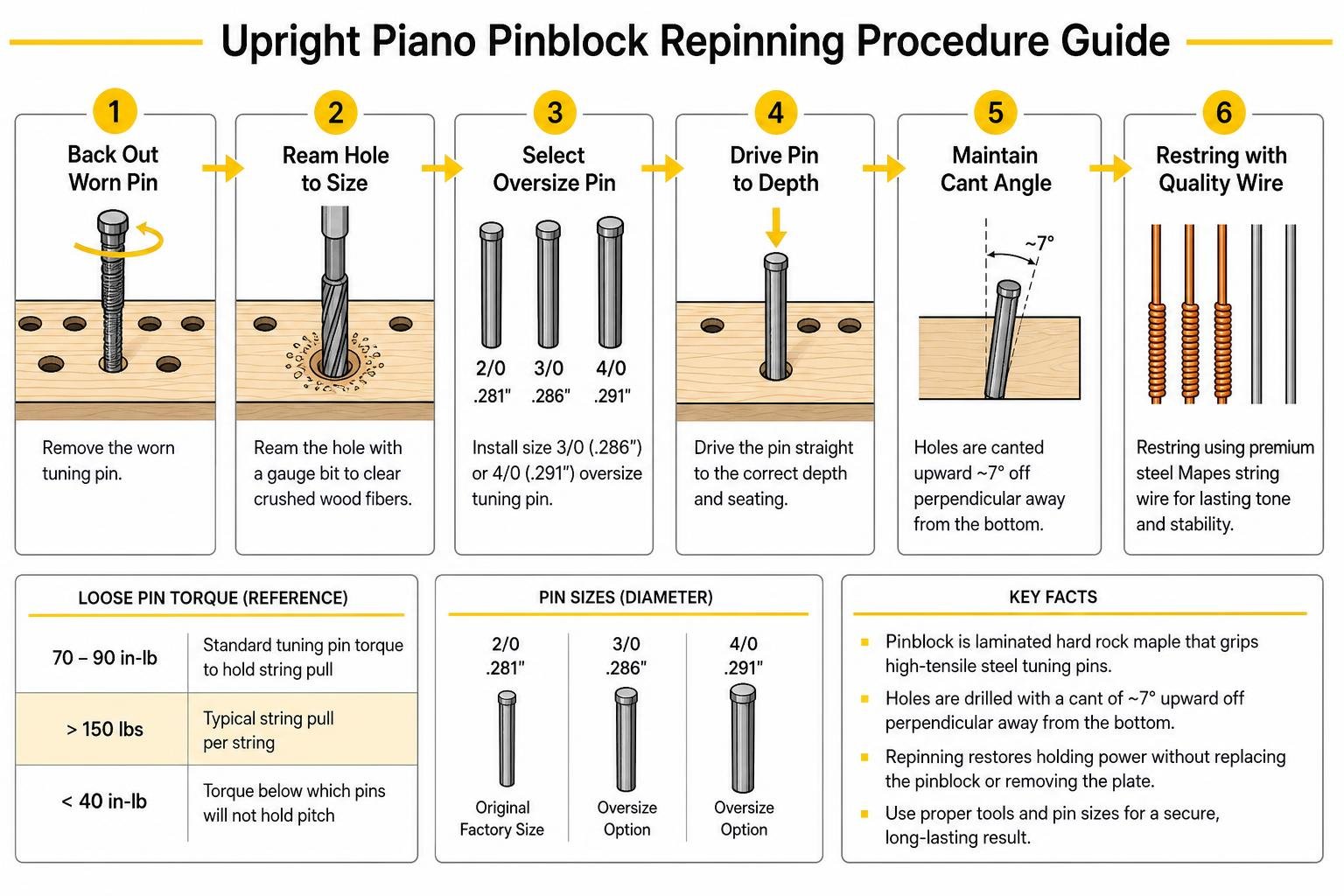
Addressing loose pins in an existing pinblock requires precise technique. Rather than replacing the pinblock—a complex process that involves unstringing the piano and unbolting the cast iron plate—technicians perform pinblock reaming and install oversize tuning pins.
Most original factory pins are size 2/0 (.281 inches in diameter). During a upright piano repair, we back out the worn pin, ream the hole with a gauge bit to clear crushed wood fibers, and drive in a size 3/0 (.286 inch) or size 4/0 (.291 inch) oversize tuning pin.
According to the Repinning and Restringing Guide, pinblock holes on upright pianos are drilled at a specific cant angle—typically tilted about 7 degrees upward off perpendicular away from the bottom of the piano. Maintaining this precise angle while reaming is essential to prevent binding or loose pin seating. When re-stringing treble sections, using premium steel Mapes string wire restores pure tonal resonance and structural longevity.
Comprehensive Assessment and Diagnostics
Before picking up a screwdriver or regulating wrench, a professional technician conducts a comprehensive assessment of the entire instrument. Beginning repairs without evaluating structural foundation elements like the pinblock, cast-iron plate, soundboard, and bottom board can result in wasted time and money on an unsalvageable cabinet.
Why every piano owner should schedule a professional piano inspection highlights how hidden structural defects—such as a hairline crack in a bridge or wood decay beneath pedal trapwork—can compromise an action overhaul.
A diagnostic inspection follows a clear sequence:
- Environmental Acclimation Assessment: Confirm the piano has resided in its environment for at least 2 to 3 weeks. Relative humidity should sit between 30% and 62%, maintaining wood moisture content between 6.5% and 10.8%.
- Structural Integrity Check: Inspect the soundboard for cracks, separation from ribs, and loss of crown. Check the cast-iron plate for fractures and verify that bridge pins are firmly set without wood checking.
- Pinblock Torque Test: Sample pin torque across bass, tenor, and treble sections using a torque wrench.
- Action and Keyframe Removal: Slide out the action stack to inspect felt wear, hammer groove depth, spring tension, center pin corrosion, and keybed flatness.
Essential Tools and Parts for Upright Piano Repair
Executing precision mechanical repairs on vertical pianos requires purpose-built hand tools designed for tight internal spaces. Generic shop tools can warp wooden action levers or mar soft brass hardware.
Key specialized tools include capstan wrenches for height adjustments, dedicated bridle strap inserters, spring hooks for pedal trapwork, and hypo oilers for targeted lubrication.
When replacing worn action parts, using pre-assembled components simplifiesfield servicing. For instance, clip-on bridle straps allow technicians to replace broken straps without unmounting individual hammer butts. High-density wool felts, replacement spring sets, and quality brass capstan screws round out the essential parts kit for comprehensive field repairs.
Step-by-Step Upright Piano Action Regulation
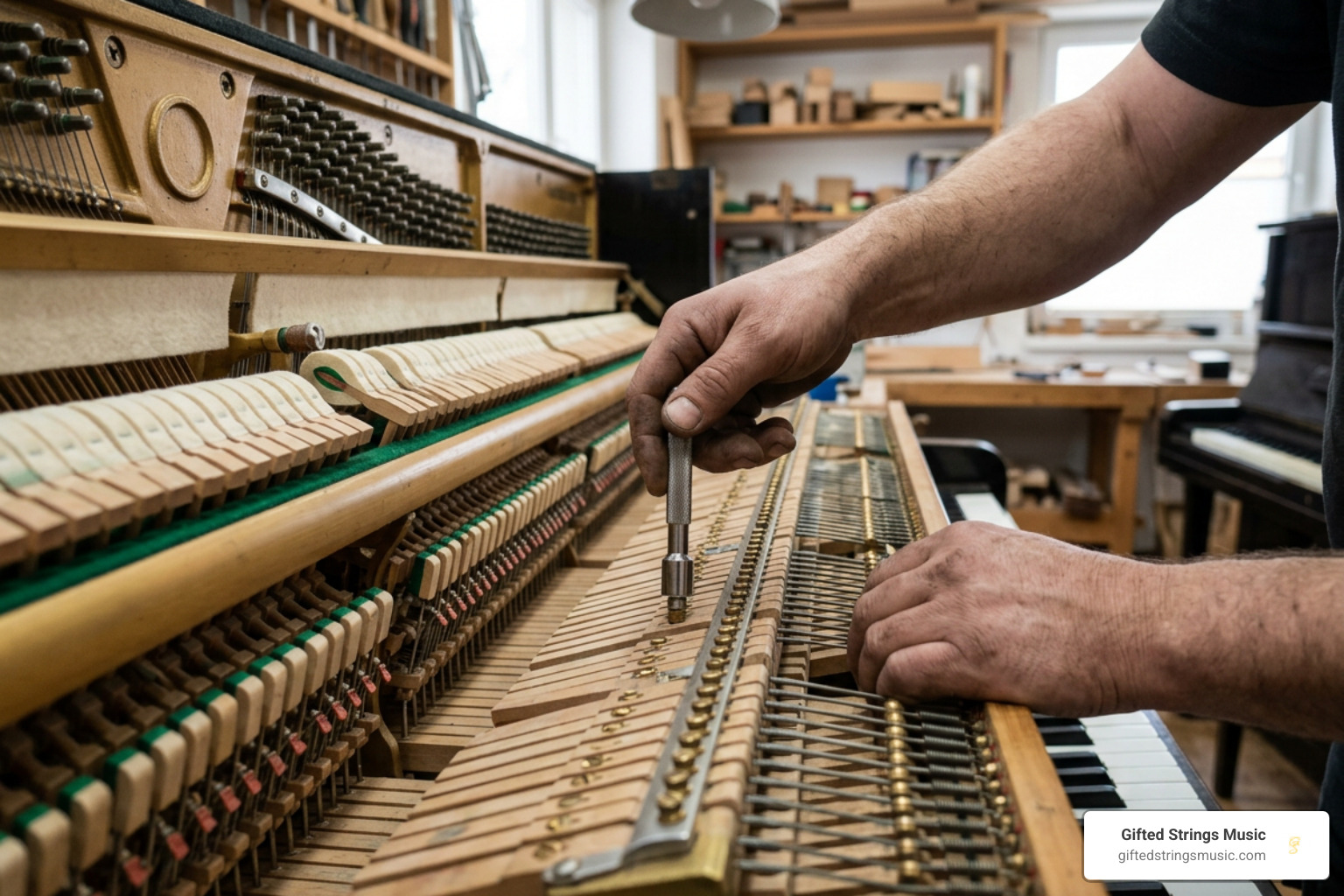
Regulation involves systematically adjusting the mechanical linkage between the keys, hammers, and dampers. Over time, compressed felt and shrinking wood throw factory tolerances out of alignment, resulting in uneven key action, lost motion, and poor dynamic expression.
According to the official Service Technicians Manual, vertical piano action regulation follows a strict sequence to ensure each setting builds on a stable foundation:
Setting Key Dip and Leveling Keys
Key leveling creates an even, flat playing surface across all 88 notes, establishing the foundation for key dip depth.
We begin by leveling the white keys. Using a long straightedge, paper washers of varying thickness (.002 to .030 inches) are added or removed beneath the balance rail felt punchings until all keys lie flat. Clearances are kept tight: approximately 0.2 mm at the balance pin hole and 0.5 mm at the front rail pin to eliminate side-play without binding.
Once white keys are level, black key height is set. A dedicated key height gauge measures the black key tops, which must sit precisely 12.3 mm (± 0.3 mm) above adjacent white keys.
Next, key dip—the vertical travel distance of a key when fully depressed—is adjusted:
- Place a standard 10 mm key-dip block on a white key.
- Depress the key until it bottoms firmly against the front rail punching.
- The block should rest perfectly flush with neighboring un-depressed key tops.
- Add or remove thin paper punchings under the front rail felt to achieve a uniform 10.0 mm (+ 0.5 mm) dip across the entire keyboard.
Regulating Hammer Set-Off and Damper Semi-Run
Hammer set-off (or let-off) is the precise point where the jack trips out from under the hammer butt, allowing the hammer to strike the string via momentum and rebound instantly. If let-off is set too wide, touch feels sloppy and power is lost. If let-off is too tight, hammers will double-strike or block against the strings, deadening the sound.
To regulate set-off:
- Turn the eye-screw regulating button on the action rail.
- Slow-press a key while observing hammer travel toward the string.
- Set the bass section hammers to trip exactly 4.0 mm from the strings.
- Set tenor and treble section hammers to trip closer, between 2.5 mm and 3.0 mm from the strings.
After setting hammer set-off, back check alignment is performed by bending the brass back check wires so the catch cushion grabs the hammer tail squarely after striking, leaving a rebound check distance of 16 to 18 mm from the string.
Finally, damper semi-run (damper lift) is adjusted. As detailed in the Upright Piano Mechanism Regulation Guide, dampers must begin lifting off the strings when the hammer completes exactly half of its forward stroke. Damper spoons are bent forward or backward using a spoon-bending tool to achieve this timing.
Damper spring tension is then balanced across the compass using specialized weights: 80 grams in the bass, 70 grams in the middle register, and 55 grams for the top treble dampers.
Repairing Bottom Boards, Pedal Trapwork, and Cabinet Base

The lower foundation of an upright cabinet endures substantial physical stress. An upright piano often weighs over 500 pounds, with that weight resting on tiny caster wheel mountings. Furthermore, every push of the sustain pedal transmits strong mechanical force down into the bottom board.
Over decades, pedal spring pressure acts like a wedge, causing grain fractures, crushed wood fibers, and loose caster sockets. Addressing base damage is critical to preventing cabinet twisting and keeping pedal mechanisms operating smoothly.
Reinforcing Damaged Bottom Boards and Trapwork
Standard wood fillers should never be used for structural piano base repairs because they lack the tensile strength needed to handle heavy mechanical loads. According to the expert guide on how to repair the bottom of an upright piano, permanent structural reinforcement requires high-grade dense hardwoods and structural adhesives.
To repair a fractured bottom board:
- Dismantle Access Panels: Remove the bottom kickboard panel and decouple the pedal lift rods.
- Inspect Wood: Check the floor timber for dry rot, stress fractures, or compression crush zones using a scratch pick or screwdriver.
- Attach Hardwood Cleats: Select 3/4-inch-thick dense maple or oak cleats. Position them perpendicular to the original bottom board grain to create a load-bearing lattice.
- Apply Structural Adhesive: Coat contact surfaces with aliphatic resin glue (carpenter’s glue) or two-part structural epoxy. Clamp securely for a full 24 hours under consistent pressure before re-attaching pedal hardware.
For worn caster sockets, drill out the splintered wood, glue in solid hardwood dowels, cut them flush, and drill centered pilot holes before reinstalling heavy-duty casters.
To restore silent pedal movement, replace compressed trap lever felt with high-density wool felt, fit fresh leather washers over pedal rod top pins, and apply dry PTFE-based lubricant to pivot points.
Evaluating Financial Feasibility: Repair vs. Restoration
When faced with significant structural issues, piano owners must balance repair costs against the instrument’s sentimental and commercial value. Piano reconditioning vs piano full restoration helps clarify when spot repairs make sense versus an extensive shop overhaul.
When Upright Piano Repair Is Cost-Effective vs. Full Restoration
For common mass-produced vintage uprights, performing a full shop restoration—which can range from several thousand dollars upward—often exceeds the commercial market value of the instrument. However, targeted in-home field repairs (such as key easing, bridle strap replacement, minor repinning, and action regulation) are cost-effective solutions that restore playability without over-investing.
Full restoration is reserved for high-end vertical models (like Steinway, Mason & Hamlin, or high-tier Yamaha U-series) or cherished heirlooms with irreplaceable family value. How Gifted Strings helps preserve family heirloom pianos for future generations highlights how comprehensive rebuilding—including cabinet refinishing, soundboard recapping, new Mapes string installation, and complete action replacement—can preserve a valued family heirloom for another century of music-making.
Frequently Asked Questions About Upright Piano Maintenance
How long does an upright piano need to acclimate before action regulation?
An upright piano must sit in its target room for 2 to 3 weeks before an action regulation is performed. Wooden action components, key levers, and soundboards expand or contract as they absorb atmospheric moisture. Allowing the instrument to reach moisture equilibrium ensures regulation settings (such as key dip, let-off, and damper timing) remain accurate over time.
What causes piano keys to stick or feel sluggish during seasonal shifts?
Sticking keys are primarily caused by relative humidity fluctuations. During humid months, balance rail key bushings absorb airborne moisture and swell around their brass guide pins, binding the key lever.
Simultaneously, indoor heating during dry winter months contracts wood fibers in the action rails and pinblock, shifting alignment. Maintaining ambient room conditions between 40% and 60% relative humidity using a dedicated humidifier or humidity control system minimizes seasonal key sticking.
Can loose tuning pins be fixed without replacing the entire pinblock?
Yes. Loose tuning pins can often be addressed without a full pinblock replacement. Technicians ream worn pin holes and drive in oversize tuning pins (moving from standard size 2/0 up to size 3/0 or 4/0).
The larger pin diameter compresses against healthy internal wood fibers, restoring the pin torque required to keep strings locked tightly in tune.
Conclusion
A well-maintained upright piano offers dynamic expression, reliable mechanical response, and rich tonal character. From resolving sticky keys and repinning loose pinblocks to executing a precise millimeter-accurate action regulation, proper care requires technical precision and deep material knowledge. Addressing minor mechanical faults promptly prevents compound wear across delicate action components, protecting your investment for decades to come.
Whether your upright piano needs minor regulation touch-ups, bottom board structural work, or a thorough diagnostic inspection, we bring over a decade of fully insured, instrument-specific expertise to every service call. Explore our comprehensive professional services or contact us to schedule a professional evaluation for your instrument today.